Chemistry Add-In for Microsoft Word

CML is Cool

  • Home
  • History
  • Download
  • Consultancy
  • Sponsors
  • Under the Hood
  • News
  • Shop
    • My account
    • Basket
  • Support ▾
    • Knowledge Base
    • Usage
    • FAQs
    • Tutorials

What’s coming up in Version 3 – A user perspective

3rd April 2017 by Clyde Davies

A completely new version of Chem4Word

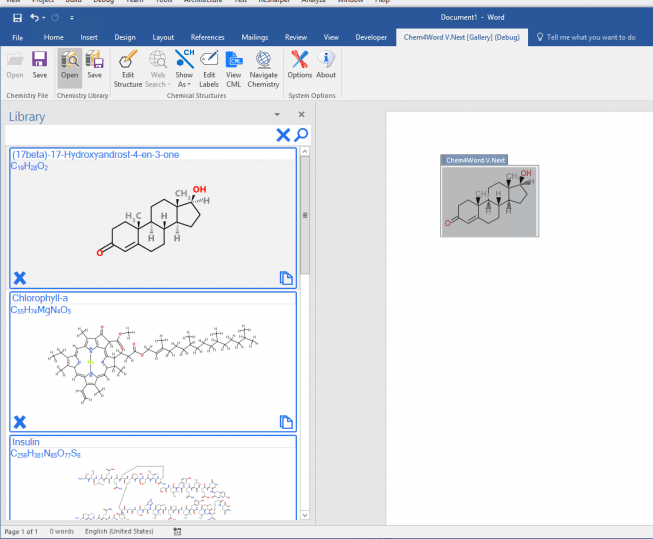
We have been working on a new version of the Chemistry addin for Microsoft Word and we’d like to show our progress so far.  The new Ribbon and Library are shown in the picture below.  We also have a new version of the Chemistry Navigator and a replacement for the old Gallery, now called the Library.
Why a completely new version?

We decided it was time to take stock.  It’s about ten years since Chem4Word was first released.  A lot has happened since then, and we wanted to make sure we could meet both present and future challenges.

What has been our approach?

We had a long discussion among the team about what direction we should take after we released the last version.  We came up with two possibilities:

  1. Enhance performance: make the product more reliable and stable, and re-write some of the code to allow it to be properly extendable.
  2.  Concentrate on providing new features

We could have followed both of these approaches  But it made more sense to put the product on a firmer footing before we built anything new onto it.

What did we do?

So, what have we done to improve the product?  Well the first thing we did was to listen to your feedback and address some longstanding gripes.

You complained about the idiosyncratic ways that Chem4Word stored its stuff in a Word document template.  So we dealt with those issues first.  Then we went on to address performance problems.  We also had some issues with the way that the Gallery and Navigator displayed structures as low-quality pictures.

You should find the new version of Chem4Word familiar. Most of the old features are still there.  We’ve just made them work much better!  And we’ve got rid of those you didn’t like or didn’t use.

Better Storage means Better Editing and Better Performance!

Our first step was to change the way that the chemistry information is stored inside the Word document, before it is presented to you in the form of a structure/label or formula in the document.  A radical change to the storage model means that you can now copy and paste structures inside a document and even between documents.

We also addressed the performance of the code that generates the structures that you see in your documents.  By changing the way the add-in works with the chemistry information in the document, we have made it very much quicker to render more complex structures with larger numbers of atoms and bonds.  To give you an idea of the speed improvement, have a look at this video that compares the performance of the current add-in with the version currently in development.

FlexDisplay

Because it’s now much easier and quicker to work with the chemistry directly, this opens up all sorts of exciting new possibilities.  On-screen rendering is now much easier than it was, so we don’t have to rely on storing the low quality bitmaps of the structure for the Gallery and Navigator tools.

We have used this new tool, the FlexDisplay in the new Navigator and the new Library to get high quality display of chemical structures in these two tools.

New Navigator

We completely overhauled the Navigator.  This lists all the chemistry in the current document, and allowing you to paste copies and links to embedded chemistry.  The new version does much the same as the old one.  It also includes new Browse buttons.  These allow you to locate and show all the instances of a given chemical within the document.
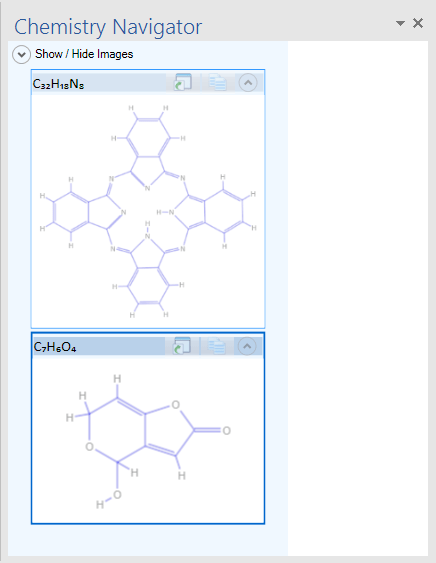
 

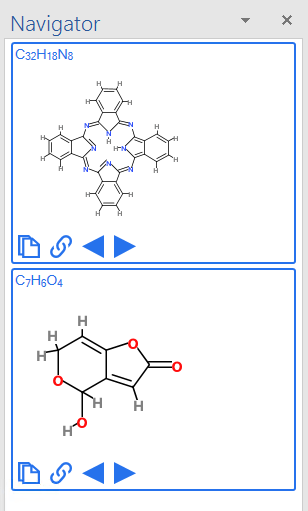
Old Navigator New Navigator

As you can see, it follows the new-look Office style.  It also uses the FlexDisplay to display chemistry, making the display much clearer (and quicker).  See how much clearer  and more colourful the structures are compared to the old-style Navigator.

Goodbye Gallery – Hello Library!
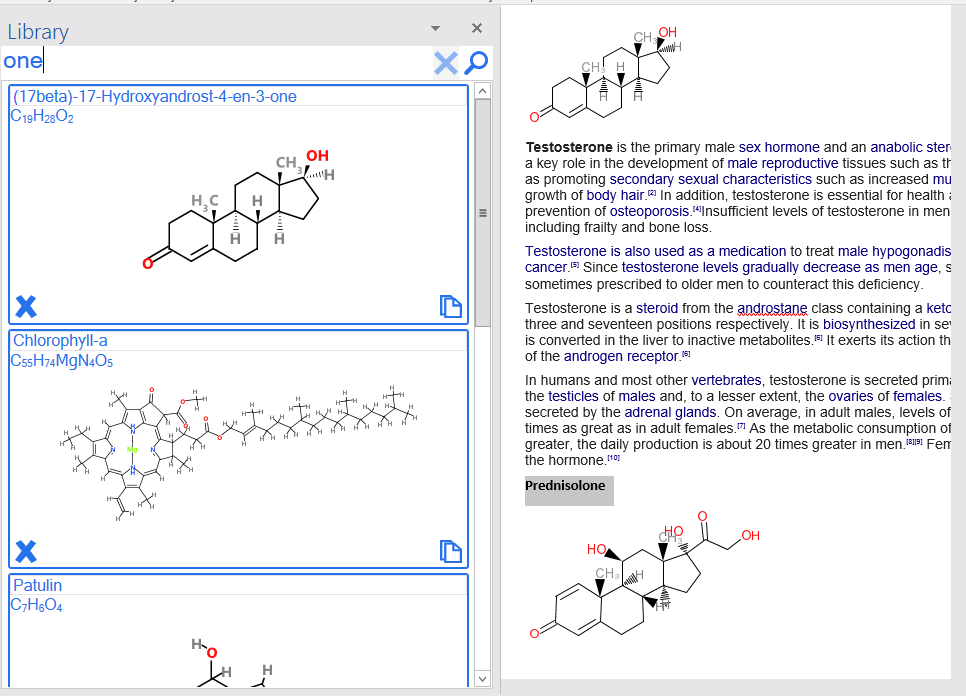
The Library in Action

One of the biggest gripes you had about the way Chemistry for Word worked was that it replaced the document’s template with it’s own version, thus eliminating any styles and other customizations you had done.

You hated this, so we have completely removed the Gallery and replaced it with a new component: the Library.  The Library superficially resembles the Gallery, but as you can see above it lives in its own task pane, flanking the document along with the Navigator.  You can save structures to the Library, change their names, and insert them wherever you want to in your document.  This is handy when you are constantly referring back to a core set of structures, say, when preparing teaching materials.

Best of all, the Library doesn’t use any templates to store its structures, so you won’t lose any document customizations that you have already made.


We hope you like the look of the changes that we’ve made and we expect to be able to release a version for you to try very soon.

Filed Under: News Tagged With: Depiction, FlexDisplay, Gallery, Library, Navigator, New Version

Next version of Chem4Word

23rd December 2016 by Mike Williams

We are starting work on the next version of Chem4Word.

What features would you like to see in it?

Please make any suggestions in the our Facebook group

Filed Under: News

We’re moving to the .NET Foundation

8th September 2016 by Clyde Davies

dotnet_logoThe Chem4Word Project began in 2008 as a collaboration between Microsoft Research and the University of Cambridge.  The project’s original instigators, Tony Hey and Peter Murray-Rust, intended to add the capability to create and edit chemical structures within the world’s most popular word processor, Microsoft Word.  This was novel enough in itself, but the ‘Chemistry Add-In for Word’ was intended to be an open source project, a radical departure for Microsoft.

Eight years on, Microsoft has since placed and supported many products into and in the open-source domain, and Chem4Word still flourishes.  Although we are a small volunteer team we have just released a major update, with dramatically improved chemical structure rendering.  Chem4Word has been downloaded over 200,000 times and has users all over the world.

We are currently planning new features that will make Chem4Word even more powerful and easy to use.  We are also optimising the storage model, which will lead eventually to performance improvements.

To help support these new developments, we are transferring ownership of the code base to the .NET Foundation.  We give our heartfelt thanks to the support that we have received from the OuterCurve Foundation over the past 8 years, and the guidance of Microsoft Research and Cambridge University.  None of this would have been possible without their original vision.

We look forward greatly to working with the .NET Foundation, in helping to develop Chem4Word into the leading freely-available, open-source cheminformatics tool.  Thank you to everyone who has contributed in whatever way to this project!

Filed Under: News

Chem4Word – Usage data collection

16th December 2015 by Andy Wright

There are lots of software products out there that collect ‘usage’ data and many of us simply accept the terms and conditions without giving it  a thought.  Chem4Word is no exception, but I thought that I would share some of it back with you!

The current beta release has been collecting information about Office version, operating system and IP address as well as other bits of data to see which parts of the addin you actually use.

CDataMike wrote some software to extract this data from the data tables in which they are stored and Clyde then used Knime to extract useful information.  I wondered whether it would be possible to extract the data directly into Knime to make the process simpler.  After a bit of searching, I found a JDBC driver (http://www.cdata.com/drivers/azure/jdbc/) written to connect directly to Azure table storage; exactly what I needed.  The evaluation version worked brilliantly and after a short email discussion, CData kindly donated a license to use this driver to the project team.  Thanks CData! We really appreciate your help!

KnimeSo, what can we do with the data, now that we’ve extracted it and processed it with Knime.  With the IP address, we can use a free lookup service (http://freegeoip.net/)  to get a city location and Knime has a node that allows us to automate this.  We can then use an Open Source Maps node in Knime to automatically show these locations on a world map!  It is really interesting to see how widely the addin is used across the world, but we’re still waiting for a user in Antarctica!

What is more usetul to us is to know what version of Microsoft Word is being used with the addin.

Supporting multiple versions of Word means we have to maintain multiple versions of the code that produces the images in the addin.  So, what have we found?

We’ll publish more data as we go on, and show you more views of the data that is so valuable to us in understanding how you use the Chemistry addin for Microsoft Word.

Filed Under: News

Latest Version Released

14th December 2015 by Andy Wright

The latest version of Chem4Word the Chemistry AddIn for Microsoft Word is available for download.  In version 3.0.*, we’ve addressed a number of issues, including the following:

  • Changed what happens when users try to copy/paste or drag/drop structures.  At present, the only way to replicate or move structures in a document is to use the Chemistry Navigator.
  • Changed the sizing and orientation of images in the Chemistry Navigator so that even large structures are displayed more clearly.
  • Made the “insert linked/un-linked copies” buttons in the Chemistry Navigator more visible.
  • Ensured that all of the prerequisites are installed along with the AddIn.
  • Fixed bug in import of double and triple bonds on structures from ChemSpider.
  • Fix bug when user edited structure, then cancelled edit labels; Resulting in loss of changes.
  • Progress bar and Editor windows should now be shown on same monitor as active document.
  • Added form for user feedback, when errors are shown.
  • Automatic check for new version.
  • Updated ChemDoodle Web to 7.0.2.

We’ve also made some changes to the way that usage data is collected to help us to understand which versions of Microsoft Word are being used with the AddIn.

Please download the latest version from here.

Filed Under: News

  • « Previous Page
  • 1
  • …
  • 3
  • 4
  • 5
  • 6
  • Next Page »

Recent Posts

  • Chem4Word – V3.3.10 Release 8
  • Why Should I Use Chem4Word?
  • SketchEl file support now included in V3.3
  • Improved Chemical Libraries are live in Chem4Word!
  • Draw Chemical Reactions Easily and Quickly with Chem4Word!

Archives

  • February 2025
  • July 2023
  • June 2023
  • March 2023
  • December 2022
  • November 2022
  • October 2022
  • March 2022
  • September 2020
  • August 2020
  • December 2018
  • April 2017
  • January 2017
  • December 2016
  • September 2016
  • December 2015
  • Privacy Policy – Chemistry Add-In for Microsoft Word
  • About Us
  • Contact Us
  • Cookie Policy (UK)

Copyright © 2026 · "Supported by the .NET Foundation" · Log in

Manage Cookie Consent
We use technologies like cookies to store and/or access device information. We do this to improve browsing experience and to show (non-) personalised ads. Consenting to these technologies will allow us to process data such as browsing behaviour or unique IDs on this site. Not consenting or withdrawing consent, may adversely affect certain features and functions.
Functional Always active
The technical storage or access is strictly necessary for the legitimate purpose of enabling the use of a specific service explicitly requested by the subscriber or user, or for the sole purpose of carrying out the transmission of a communication over an electronic communications network.
Preferences
The technical storage or access is necessary for the legitimate purpose of storing preferences that are not requested by the subscriber or user.
Statistics
The technical storage or access that is used exclusively for statistical purposes. The technical storage or access that is used exclusively for anonymous statistical purposes. Without a subpoena, voluntary compliance on the part of your Internet Service Provider, or additional records from a third party, information stored or retrieved for this purpose alone cannot usually be used to identify you.
Marketing
The technical storage or access is required to create user profiles to send advertising, or to track the user on a website or across several websites for similar marketing purposes.
  • Manage options
  • Manage services
  • Manage {vendor_count} vendors
  • Read more about these purposes
View preferences
  • {title}
  • {title}
  • {title}