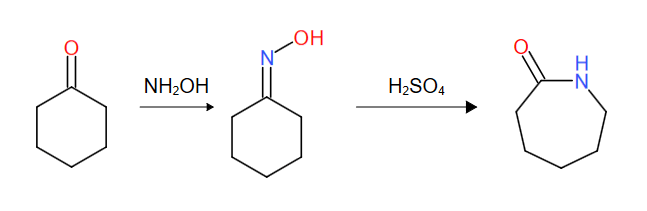
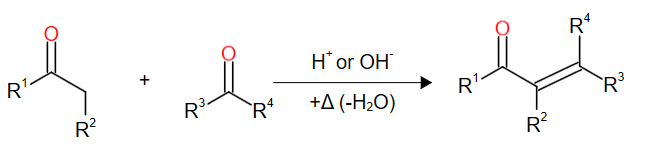
What’s in a name? That which we call a rose by any other name would smell as sweet.
If you’re an organic chemist, quite a lot, as it happens! Learning ‘organic named reactions’ is a rite of passage for all undergraduate level chemists. Named reactions are so called because they are (mostly) named after their discoverer, like say the Beckmann Rearrangement.
Or they have names that actually describe what is going on, such as the aldol condensation: where an aldehyde or ketone condenses with another carbonyl compound to make an aldol. Subsequent elimination leaves a C=C conjugated bond.
We’ve decided to create a compendium of these reactions, learned (and mostly loathed) by chemistry students through the ages. Rather than a ‘by the numbers’ recitation of the reactants, products, conditions and mechanisms, we’ll aim to shed light on the actual science that went into their discovery. Learning stuff by rote is never fun, and we hope to lighten the burden by not forgetting that science is a human story, first and foremost.
And the name of this massive and essential resource? The ‘Organomicon’! The Book of (Mostly) Dead Names1. Most of the discoverers of these reactions have gone to the Great Chemistry Lab in the Sky. We’ll add to the list of eldritch horrors regularly!
So, if you’re studying or teaching chemistry to an advanced level, or you just like looking at pretty pictures of molecules doing fun things, then bookmark this blog.
And we’ll be making available a companion Chem4Word Library at a very reasonable cost!
Our new Named Reactions Library is coming along nicely. We've just clocked 100 named reactions…
Reaction mechanisms are a pivotal teaching tool, conveying exactly how and why organic reactions work…
With this release we have added the following changes New Feature: Showing of Implicit Hydrogen…
It's a valid question. After all, there are now lots of chemical content creation tools.…
To celebrate WebMolkit having its license changed to Apache 2.0 we are working on allowing…
Libraries in Chem4Word are just what they say: collections of reusable chemistry, catalogued for quick…