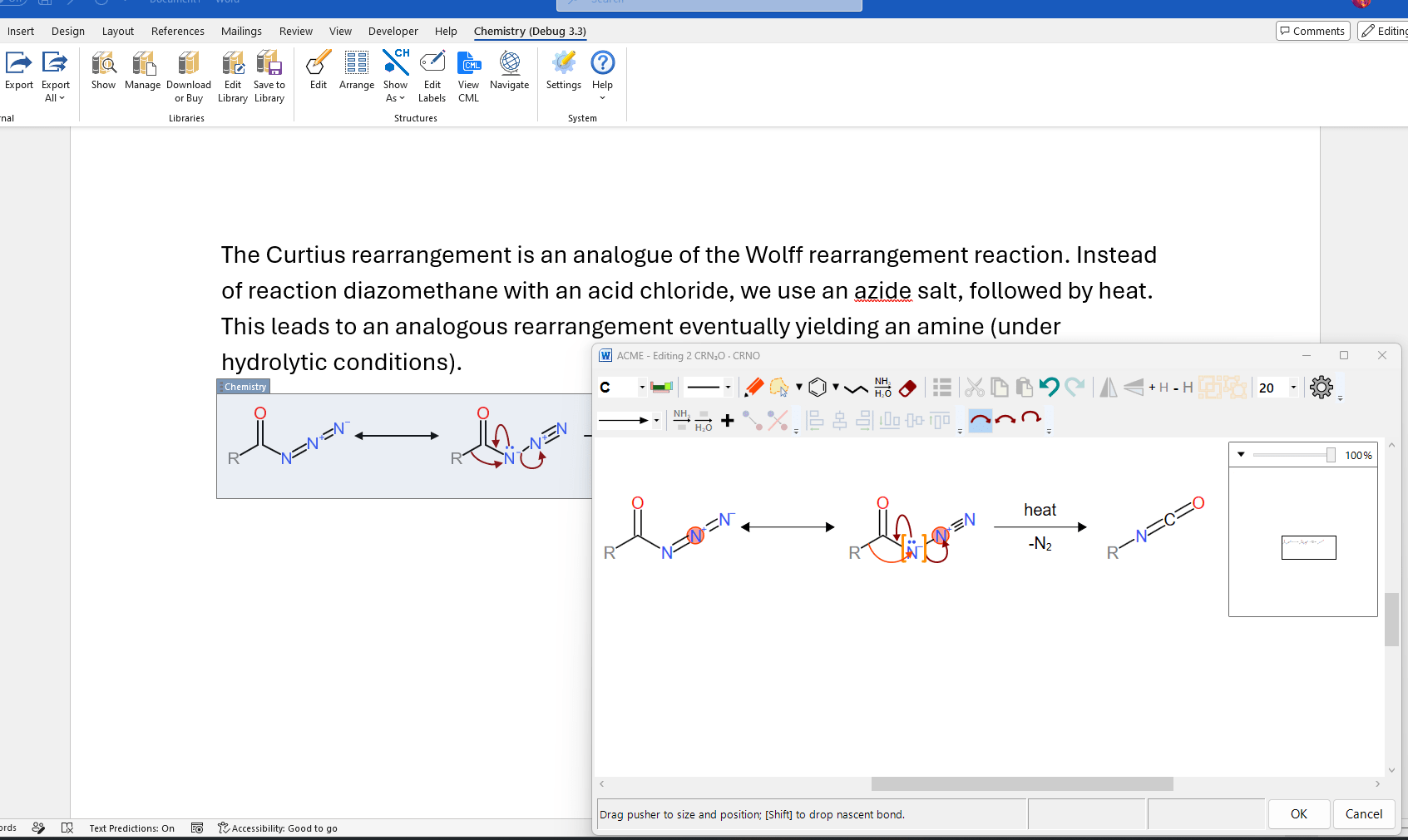
Reaction mechanisms are a pivotal teaching tool, conveying exactly how and why organic reactions work the way they do. We will soon support several electron types – radicals, lone pairs, charges and carbenoids – and the electron pushers that form and break bonds.
We’ve been beavering away on making our ACME chemical editor support these features, and on drawing them in Word. It’s been challenging work. There are a lot of subtleties about drawing mechanisms that we take for granted when using a pen and paper.
But this release will put first-class chemistry in the hands of the people who will make best use of it: the learners who will make up the next generation of chemists, and the teachers who inspire them.
You’ll soon be able to draw beautiful reactions like these. Watch this space for further developments!
What’s in a name? That which we call a rose by any other name would…
Our new Named Reactions Library is coming along nicely. We've just clocked 100 named reactions…
With this release we have added the following changes New Feature: Showing of Implicit Hydrogen…
It's a valid question. After all, there are now lots of chemical content creation tools.…
To celebrate WebMolkit having its license changed to Apache 2.0 we are working on allowing…
Libraries in Chem4Word are just what they say: collections of reusable chemistry, catalogued for quick…